Sunday, 30 April 2017

Review - "Future Leaders of Nowhere"

Future Leaders of Nowhere
by Emily O'Beirne
rating: ☆☆☆
published: 15th March 2017
spoilers? no

Goodreads

Galley provided by publisher

This book was so cute. Unfortunately, it often felt to me like there's not much more to it than that. Instead of having the camp with its political games as the central plot, and the romance the side plot, it has it the other way round, which leaves the side plot not so fully fleshed out as it could have been, and the romance is not quite strong enough to carry the book on its own.

The writing at times felt a little too much like purple prose, meaning I had points where I just kind of rolled my eyes and prayed for the story to move along already. I mean, you get things like "Because she is. Finn earths", which makes no sense. What is "to earth" even supposed to mean? That she's down to earth? Or that she's solid? Who knows.

Then there was a lot from both girls going on about how wonderful/amazing/brilliant the other was, and okay I get they're smitten but I don't need pages going on about it. It also seemed that neither would be able to admit to a fault in the other, which doesn't make for all that interesting characters, on the whole.

There were a couple of great moments later in the book, the first where Finn was like to Craig "you know bisexuality is a thing" after he points out she's been with a guy before. And the second was when Amira called Amy out for criticising her using her sexuality to get guys' doing what she wanted, and also vaguely slutshaming her. It was so wonderful. And there are so many good girl friendships going on in this book. I loved it.
Read More

Friday, 14 April 2017

Review - "The Broken Bridge"

The Broken Bridge
by Philip Pullman
rating: ☆
published: 2nd May 2017
spoilers? yes

Goodreads

Galley provided by publisher

DNF @ 45%

To be honest, I was disappointed by this one. I don't know if it's me misremembering how good Philip Pullman's writing is, or it's because this is an earlier one of his than His Dark Materials, but I was just underwhelmed by it.

The Broken Bridge tells the story of a mixed race girl growing up in a small, Welsh village in the 1990s. One day, she finds out that her dad wasn't married to her mother, as she had thought, but instead to another woman, and he'd had a child with her, before meeting Ginny's mother (meanwhile, not having divorced the first woman). And that revelation takes up the first half of the book. It's pretty tedious, to be honest. I was expecting some fantasy aspect to the book, but there was none.

It's understandable that if you're writing about a mixed race child growing up in a small, presumably relatively isolated, village in the 90s, you're going to have to touch on racism and microaggressions at some point. That's surely to be expected. Except every time Pullman approached the subject, he managed to make a mess of it. There is some clear internalised racism going on, made especially so when Ginny, who's mother is Haitian and studied art, refers to Haitian artists as "primitives".

"The lady from Haiti? They have a lot of painters there." "Yeah," Ginny said, "primitives. Peasants. I know about them. But she wasn't like that. I can't be, either. See, once you know about Picasso and stuff, Matisse, all the modern painters, well, you can't pretend to be a peasant who's never seen them.... You're stuck, really. You can't go back; you've got to go forward. My mother, she was studying art properly, like I'm going to do." "European art," Stuart said.


Ginny, herself an aspiring artist, should surely know better than to value the European artists over another style of art, let alone refer to that different style of art (coincidentally one with non-white artists) as primitive or lesser. It also seems that Pullman is using Stuart, a white guy, to tell her that this is a dubious opinion to hold. Especially when he goes on to tell her about Haiti, from his perspective (granted it's because she doesn't know because she's never been, but couldn't she have read about it at least?).

At this point, I just gave up. Coupled with the fact that the other black character, a boy who has been adopted by white parents, refers to himself as "a white kid with a black face" - which I get is intended to reference the fact he doesn't feel like he fits in anywhere but instead feels uncomfortable coming from a white author - I just had to stop.
Read More

Tuesday, 21 March 2017

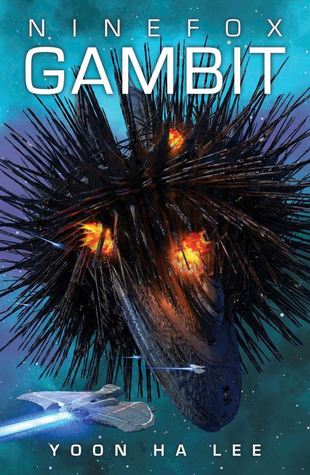
Review - "Ninefox Gambit"

Ninefox Gambit, The Machineries of Empire #1
by Yoon Ha Lee
rating: ☆☆☆
published: 6th April 2017
spoilers? no

Goodreads

tw for implied rape in a flashback scene, implied suicide attempt, suicidal thoughts

Around 270 pages into this book, having skimread a few I'll admit, I was fully prepared to rate this book 2 stars. Up until then, it had been not all that interesting, bordering on tedious, with the only real bright spot being Jedao and Cheris' interactions, and the fact that Cheris is a wlw.

The book is essentially an extended battle scene, full of pages of tactical considerations. Some of these tactics are related to battle formations, which are computed using complex mathematical calculations, and the fact that every time one was used, Yoon Ha Lee went into a lot of detail about them, the book was slowed down immeasurably. Added to the fact that you just get dropped into this world with zero explanation of how it works, and that it's actually a very complex world for a sci-fi book, I found it hard to get into.

It took me a good while to understand that this Empire was underpinned by a specific, mathematically-derived calendar, and that any deviations from this calendar (presumably made by computing something new) were heretical. On top of that, there are six factions, each charged with a different aspect of life - much like Divergent. For example, the Kel - the faction Cheris belongs to - are the foot soldiers (and pretty much cannon fodder). In the past, the seventh faction, the Liozh, had turned heretic and so were destroyed. All this would have been helpful to know from the start, but I can understand why the author might not want to add a whole section explaining the world - it often makes the beginning clunky and unrealistic.

So, as I said, this book was heading towards a two star review from me, when the last 40 pages happened.

This is one of those books that sets you up so you think you know everything for about 90% of the book and then in the last 10% is like ha lol played you. Those last 40 pages alone were enough for me to boost the rating by one star (I was tempted to rate it 4 stars actually because they even made me look back in fondness on the 270 preceding pages of tediousness) and to want to read the next book. I think that if I now went back and reread this book, I would enjoy it a lot more.

On top of this, no one in this entire universe is straight. Cheris has only ever had female lovers, Jedao has had both male and female lovers, and they're also explicitly attracted characters of the same gender. A lot of the time it feels like authors don't necessarily write that part of the LGBT character, but Yoon Ha Lee does (Cheris more than Jedao in this book, but only because it's more like her POV - Jedao gets his turn in the short story prequels). In addition, in the short story Extracurricular Activities, there's a character who uses they/them pronouns.

In the end, this was a good book. I just wish I had enjoyed it right from the start.
Read More

Friday, 17 March 2017

Review - "Penance"

Penance
by Kanae Minato
rating: ☆☆☆ 1/2
published: 6th April 2017
spoilers? some

Goodreads

Galley provided by publisher

Actual rating 3.5

Honestly, this is one of those books which I neither hated nor loved particularly much. It was a compelling mystery story, but it lacked something that meant I didn't connect with it as much as I might have.

Penance is the story of four women, 15 years on from the murder of their friend, Emily, in the village they grew up in. It's told as five separate accounts - letters or speeches or conversations - each of which provides a little bit more information about the killer. The final account is from Emily's mother, and draws the entire mystery to a close.

It's an easy and quick enough read, and the mystery itself is compelling, but there were parts which threw me, like when it turned out that Takahiro married Sae because he saw her as a human doll and he wanted to treat her as such and when it turned out Akiko's brother was sexually abusing his stepdaughter because his wife didn't want him to touch her so instead offered up her daughter and he accepted. It also felt a bit too short for me to entirely connect and sympathise with the characters (besides Yuka) . But then again, they probably weren't supposed to be entirely sympathetic.

So overall, it was a good mystery and kept me engaged enough to finish it in one night, but I never really fully connected with it.
Read More

Thursday, 9 March 2017

Review - "Letters to the Lost"

Letters to the Lost
by Brigid Kemmerer
rating: ☆☆☆☆☆
published: 6th April 2017
spoilers? no

Goodreads

"You can't make your own path with your eyes closed."


Galley provided by publisher

How do I put into words how much I loved this book? It wrecked me. I genuinely cannot remember the last time I cried over a book, but this one made me cry at least twice and tear up many times more.

Letters to the Lost is the story of Juliet and Declan, both of whom have lost someone in their family, as they start exchanging letters after Declan responds to one Juliet has written and left on her mother's grave. It's an emotional bruiser of a book, with suckerpunches coming basically every page, no holds barred. It does this all the while being a far from complex story - it's about two people finding refuge in each other, while not knowing who the other is.

It's written in dual POV, so you get to put yourself in the shoes of each person. Which is good, because a lot of times when you have a dickhead character, like Declan is painted as in Juliet's POV to begin with, you don't get a sense of how they actually are because it's single POV. And that makes any sort of character development, unless very explicitly done, hard to believe. There was one time where I was a bit confused about who's POV it was, but that was just because it didn't change when I expected it to have (there was a reason behind it though).

A lot of things about this book really messed me up. Specifically, the ones based around the family relationships. There were some scenes, mostly revolving around Declan and his family relationships, that really got to me, and those were the times I ended up crying.

I don't know if I'll read another book this year that messes me up as much as this one (although Jeff Zentner's new one is out soon and just the blurb tells me I'm going to end up in tears). I read it in only a few hours too, and then had to wait for about an hour before I could leave my room because of all the crying. It's definitely one I'll be coming back to over and over.
Read More

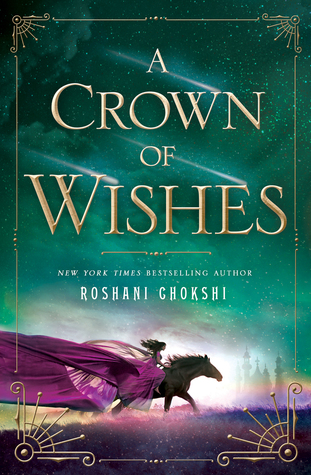
Review - "A Crown of Wishes"

A Crown of Wishes, The Star-Touched Queen #2
by Roshani Chokshi
rating: ☆☆☆☆☆
published: 28th March 2017
spoilers? no

Goodreads

And the truth was that he was not afraid of being seen for what he was. He was afraid of being seen as someone who could never be more.


Galley provided by publisher

You know when it's an author's second book and the first one was so amazing that you're kind of worried that nothing can live up to that? Not so with this one. A Crown of Wishes is as amazing, if not more so, as The Star-Touched Queen.

The writing is just as gorgeous as usual, with some wonderful descriptions (especially of food and gardens) that bring the story to life. The setting this time is the Tournament of Wishes, in which Gauri and Vikram are competing. Gauri is Maya's sister, introduced in the first book, a princess who has been in captivity by her kingdom's enemies for 6 months. Vikram is the adopted prince of Bharata's enemies, who wants to be king and to be respected by the council.

The characters are also wonderful, and so realistic and their relationship is a hate to love one, which is one of my favourite tropes ever. They start off as enemies, on account of their kingdoms, and they develop so beautifully to fall in love. And Roshani Chokshi writes it so well. And writes it without any relationship-based conflict, which I always appreciate.

I think Roshani Chokshi is one of my favourite authors, on the basis of this book and the last, and from now on she'll definitely be an auto-read.
Read More

Monday, 6 March 2017

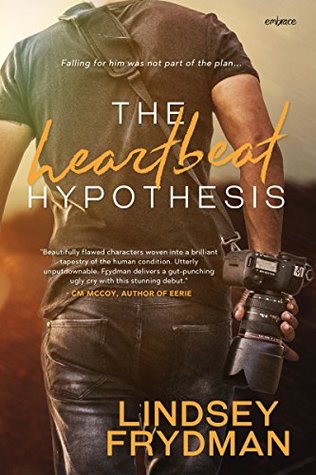
Review - "The Heartbeat Hypothesis"

The Heartbeat Hypothesis
by Lindsey Frydman
rating: ☆☆
published: 20th March 2017
spoilers? yes

Goodreads

Galley provided by publisher

Honestly, 3 stars is probably not indicative of how much I enjoyed most of this book. I say most because, for a good three quarters of it, I was really liking it. The writing was good, the story was engaging, possibly the only issue I had was how quickly they got together (I feel like a slowburn would have suited this a lot more). And then the last quarter happened.

It started off with the reveal that Jake (the love interest) had been abused as a child, as in beaten to the point where he thought he would die. Implied multiple times this happened. And because we're all about using abuse as an angsty plot point apparently, this is only ever mentioned once. Never past that.

Then, at the same time as he's telling Audra about this, he makes this comment:

"But... what about your mom? I mean, was it just your dad who..."

"My mom couldn't stop him, even if she'd wanted to. Sometimes I don't know if she did want to."

Because if she'd wanted to stop him, wouldn't she have left? For her own sake? To save her children?

"She's mentally ill," he said, sliding off the bench. "But it's never been a good enough excuse for me."


Where to even start with this. The assumption that she didn't want to stop him because she didn't leave? The victim blaming? The implication that her having a mental illness was behind her not leaving? The fact that he thinks she's using that as an excuse not to leave? It's all messy. And I wouldn't have minded it so much if the narrative had called all these things out. But guess what. It does not. This is brought up this single time, and never challenged. Just thinking about this quote makes me angry and I'm starting to wonder if I shouldn't rate this lower.

Tack onto this, the fact that, at the end, his mother burns down their house, killing herself and his father, and that this is painted as her "cracking"? Even messier.

There's also a point where Audra reads Jake's diary (violating his privacy much?) because she's so curious, and the contents of this diary imply that Jake has had or is still having suicidal thoughts. But don't worry (Jake says), he only ever thought about it, only ever planned where he might do it, he never really considered going through with it. And with that, this plot point is just brushed aside.

With all this, I feel like this book had ample opportunity to explore a love interest with a mental illness. The question is, whether I would actually have wanted it to, given how much it demonises his mother who does have one (an unidentified one, too. So don't worry, we aren't just demonising a single mental illness! It's equal opportunity demonisation).

So yeah. On second thoughts, I'm rating down.
Read More