Showing posts with label 2 stars. Show all posts

Monday, 10 December 2018

Review - "Pulp"

Pulp
by Robin Talley
rating: ☆☆
published: 13th December 2018
spoilers? yeah

Goodreads

I was really looking forward to Pulp. Historical books with LGBT characters, when they don't end in tragedy, are one of my favourite genres. And I had hopes that this one would fall into that category. Unfortunately, it turned out just not for me.

The story alternates between Janet in the 1950s, finding her first lesbian pulp fiction, and Abby in 2017, who embarks on a project for school about pulp fiction. Janet is in the throes of first love, while Abby is coping with breaking up with her first girlfriend and the falling apart of her parents' marriage.

One of the things I loved about this book was that it used the word "lesbian" a lot, and that's actually fairly uncommon in YA lit. Within the first chapter alone, it was used around ten times. Unfortunately, that kind of dropped off in favour of using qu--r (a word I'm not particularly fond of, but we'll get to that). However, it was really refreshing to see a character explicitly label themselves as a lesbian.

My favourite part of this book was the parts which discussed the LGBT community in the 1950s. LGBT history is not something I know a lot about, and it's something that's pretty much never taught, so that was really interesting. I almost wished the entire book was set in the historical context.

But, while I liked those aspects of the book, a lot of it really just bored me. It was a long book, and I wasn't actually that interested in Abby's part of the story - she seemed kind of like an overdramatic brat to me and I couldn't tell if that was there being too much of an age difference between me and her, or if she was genuinely an overdramatic brat. Possibly part of why I didn't like Abby's part was because of her insistence of using the word qu--r to describe characters in the 1950s. When qu--r was a slur even more so than it is now. I don't like applying that as a blanket term to anyone, let alone people who are (a) now dead, and (b) lived in a time when it came with such horrors. So the constant use of it in this book really put me off.

One last thing: I liked the twist at the end, because I was all prepared to be set up for Yet Another Tragic Ending (about halfway through it looked like that was going to happen). The problem was, I had been so bored by the book dragging up to that point, that I just wanted it to end.
Read More

Saturday, 27 October 2018

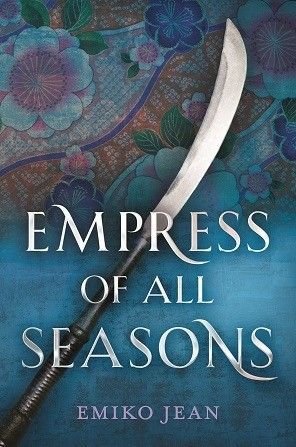
Review - "Empress Of All Seasons"

Empress of All Seasons
by Emiko Jean
rating: ☆☆
published: 8th November 2018
spoilers? yeah, fairly big

Goodreads

Galley provided by publisher

For the most part, I think this is just one of those "it's not you, it's me" books. There are reasons that I struggled with it that I know are subjective, which others may not find to be as off-putting as I did, but there were also a few points that I would say are less so.

Empress of All Seasons tells the story of Mari, a yōkai, who enters the competition to win the hand in marriage of Taro, the emperor's son. The competition involves overcoming the Season rooms in the palace, each designed by a priest to represent the four seasons. In this world, yōkai are all registered and collared, and treated as slaves, and Mari has been trained since a child to win the competition and steal the Emperor's treasury.

Initially, I liked a lot about this book - the writing was good, the characters seemed great, and I loved the concept, so I had high hopes. Unfortunately, things didn't quite pan out as I expected.

The writing got somewhat tedious after a while. I think it was partly because I took a lot of breaks reading this, and I read some books with really good writing, then coming back to this one made me realise that it wasn't actually all that good. So I got bored of it really quickly. Not to mention some of the scenes were really cringey, like, so cringey I had to skimread. Like the part where Mari confronts another yōkai in the Winter Room. Linked to the writing, I found the pacing a bit strange. Everything happens really quickly (after Mari reaches the palace) and, although it never felt underdeveloped because of that, I did feel like occasionally some scenes, particularly those where the contestants were in the rooms, could have stood some more time dedicated to them. The end was also incredibly rapid. The final battle itself isn't, and is possibly one of the only times I felt like a scene got the time it needed, but the entire bit after that is summed up in an epilogue chapter, when, quite honestly it was enough plot to take an entire other book.

As with the writing, I also started disliking the characters by the end (though never Mari, she was my favourite), particulary Taro and Akira. In fact, I just disliked Akira right from the start. He was in love with Mari, so he spent most of his time obsessing over her, and it was so damn tedious. His only motivation for doing anything was that he loved her. Like, I got it the first time Akira! Also, both he and Taro referred to Mari as "his" multiple times, because yes, of course, you love her, suddenly she belongs to you. I honestly wanted to tell both of them to get over themselves. The love triangle aspect (though was it really a love triangle when Mari didn't really seem to like, let alone love, either of the potential love interests?) just tired me out in the end.

Finally, there was a part I was fairly unimpressed by, which may or may not fall into the bury your gays trope, because it's more of a vague hint than anything and I could be taking things completely wrong. Asami, who joins with Mari in the competition (and don't get me started on how this would have been a much better ship than any of the heterosexual ones), is killed in the Winter Room, leaving Mari to become champion. Now, she's been a spy for the yōkai Resistance, headed by Hanako. On finding out about Mari's death, Hanako is upset, because she loved her. The reason why I'm not sure whether this is actually a case of bury your gays is that, while I took that to mean romantic love, with Asami and Hanako being a couple, that may well have not been what was intended. And it's also not clear whether Asami reciprocated that. But if that hint is right, then it's really disappointing because, in a book saturated with heterosexuality (there are two rōnin at the start who have a "brotherly bond", and I was like, hmmm), there's firstly, only a vaguely hinted gay couple, and secondly, one dies. So, I'd really like to give Emiko Jean the benefit of the doubt, but I've been burned a few too many times for that.

Ultimately, that's why I rated this book down to 2 stars, where I might have given it 3. That and the fact that, although the concept sounded amazing, I didn't really click that well with the execution.
Read More

Monday, 1 October 2018

Review - "Love Like This"

Love Like This, Seven Shores #4
by Melissa Brayden
rating: ☆☆
published: 16th October 2018
spoilers? no

Goodreads

Her soul soared, her heart sang, and her life could go in so many different directions.


Galley provided by publisher

I knew before going into this that Melissa Brayden's writing style is not my favourite. But, since I was able to get past it in Eyes Like Those, I thought the same would be the case here. Unfortunately, there was a lot less in this book to actually engage me and keep me interested, so the writing became painfully... well, painful.

Love Like This is the fourth and final book in the Seven Shores series, which follows a group of young to middle-aged women living in an apartment complex in L.A. In this book, the focus is on Hadley, the assistant manager at a boutique on Rodeo Drive. The plot starts with her meeting Spencer, a designer, whose collection she hopes will revitalise the store and improve profits. And, of course, they fall in love. Cue some seemingly major, but in fact minor, obstacles such as: Spencer's fear of commitment (stemming, supposedly, from the fact her parents divorced, even though they remain good friends), Spencer's new job offer, Hadley's complete stupidity regarding this job offer... I could go on, but I'll leave it there. But, to summarise briefly, all problems that could be solved with a good sitdown and some communication! (I mean, for crying out loud, when they come to realise they are In Love, Spencer flies from Paris to L.A. and Hadley from L.A. to Paris. At the same time, so they completely miss each other. When they could have, I don't know, just sent a text?)

So, yes, I had some issues with the fact that all the conflict was created by miscommunication. But, beyond that, I just didn't really get invested in either of the main characters or their relationship. There was just no tension between them. Ultimately, they bored me. The only thing I was really interested in was Hadley's relationship with the other women in her apartment complex. And there wasn't nearly enough of it. (Now, if someone could just point me to an apartment complex of wlw, please?)

There was also the slight awkwardness I felt with having Spencer written by a white author, because, on that front, she seemed condensed down to comments about white people (awkward when it's effectively a white person saying it through a character of colour), and one mention of her having brown skin. Nothing else. Maybe she's Latina (that's probably the best guess I got from the book)? Maybe she's not? It's never explicitly mentioned and she honestly does just feel like someone's taken a generic white character and then changed her skintone for diversity points.

This all being said, there were some cute moments in this book, particularly Isabel's proposal to Taylor and their subsequent marriage. But honestly, that was probably my favourite part in the book. Which really says a lot about the book.
Read More

Thursday, 9 August 2018

Review - "Outrun The Wind"

Outrun the Wind
by Elizabeth Tammi
rating: ☆☆
published: 27th November 2018
spoilers? some

Goodreads

Galley provided by publisher

To be honest, I think the hype for this book actually killed it for me. If it hadn't been so hyped and I came to it with no expectations, I'd have probably liked it more than I did. Because the writing is pretty good, the characters were alright, and there's a good romance. But it was hyped, and so I'm disappointed in how it turned out.

THE GOOD

- The relationship between Atalanta and Kahina was well-developed and nicely slowburning. They start off disliking each other - or rather Kahina dislikes Atalanta for reasons she can't actually explain to her, and Atalanta dislikes her in response to that - and then come together to work against the suitors later on. You might say that they start liking each other fairly abruptly, but besides that the development was realistic.

- The writing wasn't awful. OK, I'm definitely framing that in a negative way but I mean like. It was alright. Not much more, not much less. Readable, but nothing special.

- The characters were good - maybe not very nuanced - but they were good characters. I just didn't really like any of them particularly, which was unfortunate. I think if I'd liked them, things would have gone better for me.

THE BAD

- Just to clarify, I don't mean bad bad, but more like these-are-the-things-I-didn't-like bad.

- It just felt like your generic superpowered fantasy (albeit with an f/f relationship), where the characters happened to have names from Greek myths, and not actually a Greek myth retelling. I know, in the author's note, it said that she did research and took certain historical and mythological licences when writing it, but it doesn't even feel like it's actually set in Ancient Greece. Part of that was because of the language used ("insane", "lieutenant" are the examples that stick out), and the descriptions of their clothing (calling what Ancient Greeks wore a "dress" doesn't help in making it seem believable). Overall, though, besides the names for things, there didn't feel like that much effort in worldbuilding. I couldn't help comparing it (unfavourably) to Madeline Miller's novels in the end, because those are examples of how to take some liberties with the myth and still have it feel like it's actually set in Ancient Greece.

- Also, I know in the author's note she does mention that in the time of the myth - 3500BC or so - there wouldn't be coins as money and some of the city states wouldn't have been formed (although in the book she actually does have these things), but it's that kind of thing that takes me out of the story. Specifically in this book, I was taken out the story when Kahina started teaching Atalanta about forks. Which, as the smallest bit of research would tell you, were not used in Ancient Greece. Forks as we know them weren't actually used in the west until only a few centuries back. And that kind of anachronism really annoys me for some reason. It's the kind of detail that makes me think that, while there might have been plenty of research gone into the myth itself, research into the era might have been overlooked.

- There was plenty of plot to this book, but even so, I actually found it fairly boring. I think that's mostly linked to the fact that the writing was only alright, but also a bit to my next point.

- I didn't like any of the characters. Don't get me wrong - I didn't dislike them. But I just didn't actually like them. Ultimately, I didn't care about them, which would be a major factor in me liking a book (second to good writing). They are good characters, like I said before, but I didn't care.

- Finally, I just couldn't see Apollo as an out and out villain. Maybe part of that is because of Rick Riordan and the way he writes the Olympians. But for whatever reason, it just didn't work for me.

So yeah, in the end, this was just one of those books that was overhyped for me, meaning I didn't like it as much as I was hoping to.
Read More

Sunday, 10 June 2018

Review - "Lancelot"

Lancelot
by Giles Kristian
rating: ☆☆
published: 31st May 2018
spoilers? none

Goodreads

Galley provided by publisher

If I'm entirely honest, my rating for this book went down the more I read of it. And that, I think, is less to do with the book itself and more to do with me. Because me and long books? We don't get along so well, especially if it's a slowburning long book like this one.

I'll start with the good parts of this book: the writing and (some of) the characters. The writing was so good - it was so evocative and atmospheric. My only problem with it was that it sometimes bordered on overly descriptive and therefore somewhat slow. And for a 512 page long book, I need something a bit faster. Some of the characters (and when I say some of, I mean, the male characters) were really well developed and I did like them - namely Lancelot and Arthur - so the end really hurt, even though I know Arthurian legend is tragic and I was expecting it. What let this book down, besides the slow pace of it, was the women in it.

Before I start on my issues in that respect, I know it's supposed to be period typical sexism and all, but even so, that as an excuse feels fairly cheap when it's a man writing it. The misogyny starts early on: in the first few chapters, Lancelot sees this girl, Celice, singing, to attract people to her father's stall. Now, Lancelot doesn't speak to Celice, just watches her a couple of times, but when one day he finds her being whored out by her father, it's all like she's betrayed me. Bear in mind he's not spoken to her at all, only seen her a couple of times, doesn't know her, and it's her father's fault that she's in this position. And yet, she is the one who betrayed him. Plus this whole little episode is never mentioned again after it happens - it literally has no goddamn point! So, that was the point at which my rating went from a potential four stars to three.

Secondly, there's an attempted rape scene about 45% of the way into the book, in which some sailor attempts to rape Guinevere. Because what is a book set in the 5th century without a rape scene, huh? It's pretty much absolutely necessary, right?

I have to admit, I did think about giving up, but instead I decided to keep reading. And got to the following line:

Tits you could hang your helmet and shield on.


And at that point I really did start just skimreading a lot of this book. Because not even good writing can keep my interest that well when there's all this casual misogyny, period typical or otherwise.

In addition to these small bits of misogyny, there was the rather larger issue I had with the female characters, of which there were only two who could actually be considered main characters: Nimue and Guinevere. Neither of them were particularly fleshed out - Nimue you can summarise as the mysterious and magical lady, and Guinevere as the beautiful princess who everyone loves. And that's about it. If they had their own desires and thoughts, it was not something they ever expressed (and I know, it's in Lancelot's POV so that's hard, but I have read books in first person that don't fail to make their female characters, or even just their side characters, three dimensional).

So yeah. In the end, the misogyny just got to me, and this book went from being a potential 4 star rating, to 2 stars, as you see now.
Read More

Monday, 4 June 2018

Review - "A Lady's Guide To Etiquette And Murder"

A Lady's Guide to Etiquette and Murder, A Countess of Harleigh Mystery #1
by Dianne Freeman
rating: ☆☆
published: 26th June 2018
spoilers? none

Goodreads

Galley provided by publisher

For the most part, I was pretty bored by this book. None of the characters really engaged me, the relationship had no tension, and honestly? There was hardly even a serious mystery or any investigating done. In all? Boring.

My major problem was just not feeling anything for the characters. The only one I really liked was George, but even he irritated me at times (the overprotectiveness trope can die already). The rest I just didn't care enough about. That may have partly been behind my lack of investment in the relationship between George and Frances too. I love a slowburn, but there was just no tension to this one. They didn't even really interact that much before starting to call each other by their first names, so there wasn't that much development going on either.

In terms of the plot - there really wasn't that much investigating going on until beyond the halfway point. It just kind of drifted along for most of the book, then all of a sudden the mystery is solved. Not to mention the blurb made it sound like Frances being accused of Reggie's murder was going to be a bigger plot point than it was - it ended up being pretty much brushed aside in the end.

It was also really hard to work out when this book was supposed to be set. I assumed kind of Austen era, but then there are telephones and cars, so obviously it's later than that. It just didn't really have a distinctive feel to it. It could almost have been any time.

So, yeah. Overall, I just didn't have a good time of it with this one.
Read More

Saturday, 19 May 2018

Review - "Cloaked in Shadow"

Cloaked in Shadow, The Dragori #1
by Ben Alderson
rating: ☆☆
published: 5th December 2017
spoilers? a bit

Goodreads

I think the best word to describe my experience with this book is disappointed. It wasn't that I had overly high hopes for this book that weren't met - more that, the more I read of it, the less I really liked it.

Putting aside the issues I found with the editing (three times your instead of you're, and once vile instead of vial), the writing really wasn't that amazing. And that was fine, for the first 60% of the book or so, but then it got tiring. I was all prepared to rate this book 3 stars, maybe 3.5, up until the writing started to grate, but after that it was all downhill. Not only that, but some aspects of the plot and characterisation gave me real SJM vibes. If you like her books, you'll probably like this one, but as I'm sure I've made clear, I am not a fan to say the least. So those vibes did not go down well.

More majorly, the characterisation felt really off for me. The characters were fairly shallow (I really couldn't tell you much about any of them, not gonna lie), and felt inconsistent at times. Not to mention all the growling when someone they liked was anywhere near someone who might or might not be flirting with them (okay, okay, it was once, but once feels like a lot when it's a trope you hate to death). Because the characters were shallow, the relationship development was also shallow, maybe even non-existent. Yes, they didn't jump into bed straightaway, but there was hardly any change in how they behaved around one another from 10% in to 70% in when they kissed. It was honestly fairly boring. There was also the relationship between Zac and Petrer, which seemed to oscillate back and forth between Zac being friendly and apparently forgetting that Petrer cheated on him (a fact which Petrer shows no remorse for), and Zac being cold and blanking him. He cheated on you Zac! He's not even sorry! Just break it off with him completely and be done. (Don't then be disappointed when he hurts/betrays you even if he's possessed. Or at least, if you are, make your mind up on it earlier!)

The conflict right at the end also came right out of a SJM book. I mean, evil magick possession? Collar-esque devices stopping you from using magic? It's overdone. And there was some torture thrown in there too to top things off! The King tortured horrifically his own son, and I really don't understand why that was put in there. Granted it was off-screen but. Was that really necessary? Can you not set up the premise for book two in any other way?

Having said all this shit I didn't like about the book, it's only fair I end with things I did like. The worldbuilding was good, I really enjoyed that. I also loved that it had a gay romance in, but made it feel completely normal. No homophobia shoehorned in - none of that, even though it's a fantasy world, you gotta have homophobia amirite - and the relationship didn't feel like it was forced into the book (even if it was shallowly developed).
Read More

Wednesday, 28 March 2018

Review - "The Art of Escaping"

The Art of Escaping
by Erin Callahan
rating: ☆☆
published: 19th June 2018
spoilers? yeah, some

Goodreads

Galley provided by publisher

Perhaps the reason that this book disappointed me so much was that I was expecting it to be wlw. But it wasn't. And instead, I got a cishet character who kept implying that keeping a secret about escapology was in any way comparable to being in the closet. But I should back up a little.

The Art of Escaping tells the story of Mattie, who is obsessed with old escapologists such as Harry Houdini and Dorothy Dietrich. Living in the same town as Mattie is Miyu, the daugther of an escapologist herself, and Mattie decides that she's going to get Miyu to teach her escapology. She also decides that this is a deep dark secret which no one must find out about. (Yeah, this bit lost me too. Because what exactly are going to be the repercussions of doing escapology? Are you going to be ostracised from your family and friends? Is anyone really going to give a monkey's? Probably not.) One night, she's performing, and sees Will, a schoolmate, in the audience. And this is the bit that annoyed me. They swap secrets in some kind of "mutually assured destruction" deal. Mattie's secret is that she does escapology. Will's secret is that he's gay. And to be blunt: these are not nearly comparable. In no way does keeping a secret about escapology measure up to keeping a secret about your sexuality. Like I said earlier, is someone finding out you do escapology possibly going to result in ostracisation, some form of abuse, or whatever else you might think of? No. It's not. So reading a book that for 81% (I counted) implied that they were comparable was a bit of a slap in the face. And I know that, yeah, she has an epiphany late on that perhaps Will's secret is a little bigger than hers, but I really didn't have the patience for it given I'd had to read almost all the book with her blandly asserting that this wasn't the case, that they were comparable.

Besides all that, there were other aspects which annoyed me. (One note: I can't work out if I was annoyed by these things because the whole "comparing escapology to being in the closet" riled me up That Much, or if these were genuinely annoying things, so. There's that.) Firstly, Mattie gives off distinct "not like other girls" vibes, despite not actually saying those words aloud, and she's fairly sanctimonious about those "other girls". Secondly, everyone in this book goddamn whines. I swear to god, every other speaking verb was whined and it made me so frustrated. If I could be bothered, I would count the number of times each character was described as having whined, but Mattie was by far the worst of them. Just please, find some synonyms or something. Or just use said. No one notices if you overuse said.

The final points are mostly surrounding Will (my favourite character, it was an absolute travesty that he only got one chapter for every four or five Mattie got). Mainly, I am so tired of having high school age gay characters in a relationship with college age characters. I know Will was 18, but he was only just 18, and an 18 year old with a 21 year old? Makes me fairly uncomfortable. I'm 21 and I wouldn't even consider 18 year olds, that's just creepy. There's also a comment that Will makes at one point about someone being "an easily identifiable member of team-QUILTBAG". Firstly, what is people's problem with avoiding LGBT as a descriptor? Why am I having to read ""QUILTBAG"" in an actual published book? Secondly, way to stereotype I guess. An "easily identifiable member". What makes them "easily identifiable"? Because unless they're wearing a gay pride flag or holding hands or something, seems to me that means there's stereotyping going on.

Finally, there's a comment that Mattie makes within the first couple of chapters, when the guidance counsellor is asking her about joining school societies.

"Gay Straight Alliance?" "I'm apolitical."

Nice to know that LGBT people's existence is still considered political in 2018, I guess.

At least Will wasn't outed for the angst though, right?
Read More

Wednesday, 13 December 2017

Review - "Winterglass"

Winterglass
by Benjanun Sriduangkaew
rating: ☆☆
published: 5th December 2017
spoilers? hints

Goodreads

Galley provided by publisher

I am angry at this book. Angry because that's not an ending. Angry because there's throwing you straight into a world, but then there's lazy worldbuilding. Angry because of the lazy characterisation and lazy relationship development. But mostly angry because I put up with all that in the hopes that I'd get a satisfying ending and I didn't.

(But Charlotte, you say. Life often doesn't have satisfying endings. Yeah, but this ain't life, is it. This is fiction, and I would like my satisfying ending.)

But, ranting aside, this book did nothing special for me. Sure, it had potential, but ultimately, it was just a bit too short to live up to it. Short and underdeveloped.

The two main characters are primarily archetypes: the perfect warrior, and the loyal general. They aren't ever seen as much more than that, and it's boring. Because these are the people I'm supposed to be rooting for (though how I can root for Lussadh, the loyal general of a colonising invader, when she is so completely loyal she believes the invader to be right in every aspect, I don't know - but that's a whole other kettle of fish). And I just didn't connect, because they didn't seem to be anything beyond those archetypes.

Then there's the fact that there's never any intensity to any of the scenes. Not the fight scenes, and not the sex scenes. You know, the two types of scene in particular where you might want there to be something on the line? And also, you're telling me that Nuawa, the perfect warrior, meets no one close to her match in a tournament of 400 people? That she passes through it perfectly, almost without even having to break a sweat? Heck, even having one battle put in where she doesn't win it easily would be enough to raise the intensity. As it is, we breeze through these fight scenes (I'm not kidding, they take 2 pages, maximum), without any conflict. What would have happened to Nuawa's plan to assassinate the queen if she had failed at any point to become part of her army? What if she'd ever been in a position where that would have threatened to have happened? Who knows, because she's never put there. And it's frustrating because there's so much more that could have been done, but no. She's the Perfect Warrior, and thus will not be defeated.

The lack of intensity in the sex scenes also arises from their shortness, but also from the fact that the characters don't seem to have any personality of their own (archetypes, remember?), and it's just boring. Give me more. Actually develop the relationship. It's not even instalove here, it's just shoving two people together when they have no chemistry and being like "now kiss". Does not work.

And, finally, the ending. Don't even get me talking about that ending. It's like this isn't actually a standalone book. Like maybe the author planned another. Well, you're not getting me with that hook. I'm out.
Read More

Sunday, 23 July 2017

Review - "Daughter of the Burning City"

Daughter of the Burning City
by Amanda Foody
rating: ☆☆
published: 7th September 2017
spoilers? yes, big ones

Goodreads

Galley provided by publisher

Quite honestly, this book was a letdown. It was one of those ones that has an amazing idea, and an intriguing synopsis, but when you get down to it, it's just a bit lacking.

It started off so well. There was just the right amount of worldbuilding and plot mixed together, and the characters were interesting and novel. The mystery was introduced early on, and all in all it looked to be heading in the right direction. Sadly, things just went a bit downhill from there on out.

Firstly, there's the romance. It is, frankly, tedious and underdeveloped. Sorina meets Luca about a quarter of the way through the book, and by the halfway point, has effectively fallen in love with him (which covers the timespan of maybe a week or two in the plot). To add to this, he's a dickhead. And there's not much redeeming about him. It's really, really not clear why Sorina at all likes him, beyond for his looks.

Once I found the romance tedious and underdeveloped, I started seeing the plot as a whole as that too. It claims to be a mystery, but there is very little actual investigating that goes on in the narrative - it's all hidden from the protagonist, and all done by Villiam and Luca. Not to mention that whenever Sorina is investigating with one of them, they always take over everything so she ends up doing nothing, actually seeming a bit boring in terms of characterisation in the end. And she believes whatever they tell her (which, fair enough, sets up the finale but doesn't make for that interesting a story for me).

There was also the initial plot twist that Luca was a spy, which I honestly saw coming a mile off. To be fair, I didn't see the rest of it coming, and I was momentarily interested to see whether the author had the guts to stick to Luca being a spy, and not having some deus ex machina moment where it turns out that he's a) framed, or b) redeemed. Unfortunately, she didn't. Then it also turned out that Luca was an illusion too, and yet the romance continues. No offence, but it seems a little... iffy? He claims he's his own person etc, etc, but can that really be confirmed? She can control him because he's an illusion. It seems messy to me. There were definitely some other promising plotlines. The whole part with the Alliance was so interesting, but because it fell outside of the Festival's bounds, it was done away with in a quiet manner, which was disappointing. I also love when authors slot in some diversity, almost as an afterthought. Sorina is bisexual, but it's only mentioned once at the beginning and then never touched on again. It would be nice to see some evidence of that in the text. Even worse for me though was the mention that came about 85% through about her anxiety,
"How could I possible lead Gomorrah when I can't even protect my family? When my anxiety threatens to send me into a panic every night?"
Which had never previously been shown in the book, let alone mentioned. So, apologies for not considering this to be good rep. My least favourite thing about this book was the whole "it makes sense he likes her because only a "freak" can like another "freak" in that way" narrative. She actually twice says something along these lines, the second case of which is:
"He was made to love me. That's the explanation. Only someone forced to could actually love a freak like me."
Given that she's a "freak" in part because of a physical disability, I'm really really uncomfortable with this rhetoric. And, guess what, it's never called out or challenged. She's just allowed to think that. I did like one thing about this book: there was some diversity in sexualities. As previously mentioned, Sorina is bisexual, but Nicoleta is also a lesbian. As well as that, Luca is demi. So it's a more interesting foundation than other fantasy books I've read recently, but it's really only ever mentioned, and I kind of need more than that. So overall, I was disappointed by this book. It promised so much, but in the end returned so little.
Read More

Sunday, 2 July 2017

Review - "Shattered Minds"

Shattered Minds, Pacifica #2
by Laura Lam
rating: ☆☆
published: 15th June 2017
spoilers? nope

Goodreads

Galley provided by publisher

I think it's safe to say that me and present tense narratives do not get along. That's not to say that's the sole reason for my low rating of this book, but it's a big one. And when it's present tense for both the present and past (besides Carina's memories), that just makes things even more confusing. I don't know exactly why I have a problem with present tense narratives, but I can't name any books that have used one that I've particularly liked.

On top of the present tense writing, some phrases just came across as purple-prosey, forced, and downright cringeworthy at times. There were scenes which sounded exactly like badly written action film scenes (you know the type) and it just didn't work in a book.

I mostly found the plot of the book boring, to be honest. Firstly, it was hard to sympathise with a serial killer as the main character (though granted she only killed people who had themselves committed terrible crimes, and only in her drug-induced world, but it still was hard to connect to her). Also, I didn't really need all the graphic descriptions of exactly how she was fantasising killing people. Thanks, but no thanks.

Secondly, the story never really seemed high stakes enough. Sure, there was the risk of death if any of them actually got caught, but it honestly never really seemed like the bad guys were even getting close. There was one close shave that seemed like it was slotted in to try raise the stakes, but it still didn't help.

The whole idea of the plot was great, and I really thought I'd like it, but in the end, I was just a bit bored by it all.
Read More

Thursday, 15 June 2017

Review - "City of Saints and Thieves"

City of Saints and Thieves
by Natalie C. Anderson
rating: ☆☆
published: 6th July 2017
spoilers? nope

Goodreads

Galley provided by publisher

City of Saints and Thieves was one of my anticipated reads for this year. From the synopsis, the book sounded as though it had a lot of potential to be amazing. Unfortunately, I didn't enjoy it as much as I would have liked.

Most of the problems I had stemmed from the fact that the author of this book is white, and writing about Kenyan and Congolese characters. I realise that she has worked with Congolese refugees in Kenya and everything, and that's where some of the background for this comes from, but it's very very obviously written by a white author. And because that's how it felt, I had trouble actually getting into this book, and couldn't really connect with any of the characters.

I also had issues with the actual plot. It's supposed to be a murder mystery kind of thing, but if we're honest, there's actually no real investigating done by the main characters. It's all sort of reading through police reports and mumbling about how they need to do x and y, and then they go to the tech whiz and he gets it for them in a flash. Then the reveal comes out of nowhere. They don't even get close to finding out who might be behind it. They have no idea, but the bad guy then reveals his hand by kidnapping them even though they don't know who he is until that point. For this to be an effective mystery, you have to at least have them uncovering something that points towards the culprit. Otherwise it feels like the author's just gone and added it in as an afterthought.

The rest of what annoyed me was mostly just the usual YA stereotypes - of course the main character is incredibly pretty, it's just not going to work as a book if she isn't, and of course the gay character is camp as hell just so he can be slight comic relief, and of courseshe's not like other girls (she actually said this. My eyes near on rolled out my skull). So yeah. It was disappointing to say the least.
Read More

Monday, 6 March 2017

Review - "The Heartbeat Hypothesis"

The Heartbeat Hypothesis
by Lindsey Frydman
rating: ☆☆
published: 20th March 2017
spoilers? yes

Goodreads

Galley provided by publisher

Honestly, 3 stars is probably not indicative of how much I enjoyed most of this book. I say most because, for a good three quarters of it, I was really liking it. The writing was good, the story was engaging, possibly the only issue I had was how quickly they got together (I feel like a slowburn would have suited this a lot more). And then the last quarter happened.

It started off with the reveal that Jake (the love interest) had been abused as a child, as in beaten to the point where he thought he would die. Implied multiple times this happened. And because we're all about using abuse as an angsty plot point apparently, this is only ever mentioned once. Never past that.

Then, at the same time as he's telling Audra about this, he makes this comment:

"But... what about your mom? I mean, was it just your dad who..."

"My mom couldn't stop him, even if she'd wanted to. Sometimes I don't know if she did want to."

Because if she'd wanted to stop him, wouldn't she have left? For her own sake? To save her children?

"She's mentally ill," he said, sliding off the bench. "But it's never been a good enough excuse for me."


Where to even start with this. The assumption that she didn't want to stop him because she didn't leave? The victim blaming? The implication that her having a mental illness was behind her not leaving? The fact that he thinks she's using that as an excuse not to leave? It's all messy. And I wouldn't have minded it so much if the narrative had called all these things out. But guess what. It does not. This is brought up this single time, and never challenged. Just thinking about this quote makes me angry and I'm starting to wonder if I shouldn't rate this lower.

Tack onto this, the fact that, at the end, his mother burns down their house, killing herself and his father, and that this is painted as her "cracking"? Even messier.

There's also a point where Audra reads Jake's diary (violating his privacy much?) because she's so curious, and the contents of this diary imply that Jake has had or is still having suicidal thoughts. But don't worry (Jake says), he only ever thought about it, only ever planned where he might do it, he never really considered going through with it. And with that, this plot point is just brushed aside.

With all this, I feel like this book had ample opportunity to explore a love interest with a mental illness. The question is, whether I would actually have wanted it to, given how much it demonises his mother who does have one (an unidentified one, too. So don't worry, we aren't just demonising a single mental illness! It's equal opportunity demonisation).

So yeah. On second thoughts, I'm rating down.
Read More

Monday, 29 August 2016

Review - "Hot Head"

Hot Head Head #1
by Damon Suede
rating:☆☆
published: 15th June 2011
spoilers? a bit

Goodreads

Where to start.

Firstly, this book was basically a game of spot the stereotype. It opens up in a bar, where a stereotyped Latino is itching for a fight, and yelling homophobic slurs, while his stereotyped Latina girlfriend is holding him back (or hiding behind him, I didn't quite get that). Exactly what you want to start with, isn't it?

I continued reading anyway, because why not, and got to this lovely quote:

Here, Tommy liked getting half-raped on his knees.


I'll just leave that there...

Also then there's a description of eyes like gypsies, which, disregarding the WTF-ness of it for a brief moment, doesn't make any sense whatsoever.

There were a multitude of... interesting, to say the least, descriptions of cocks in this book. It got referred to as,

- a spike

- a medium rare steak (multiple times)

- an apple (I don't get this one at all)

- a battering ram (lovely)

- a tusk

- (my personal favourite) a piglet with a wet nose (this was actually said by one of the characters too)

Moving on to the sex itself, it's never a good sign when a) I'm wanting to skim read the scenes more than usual and b) I burst into laughter more than I would normally. Both of these things happened in this one. Lemme give you a rundown,

- Dante at one point was chewing Griff's arsehole. Now, I don't know about you, but I wouldn't have thought that's a) particularly possible and b) that much of a turn-on (I mean, it sounds kind of painful). Each to their own I guess.

- Suddenly, Dante impaled himself on the stout invader. Sounds bloody painful if you ask me.

- ...roaring and nailing Dante to the sofa. O-k-a-y.

- You're so fucking responsive. Like a big horse. Because everyone wants to be compared to a horse by their significant other, really.

- ...hung like an ox. See above, but with an ox instead.

Another major gripe I had was this part,

"I could bang women, but I don't wanna." " Which makes us gay, Dante."


Actually, it doesn't. But y'know, let's just stick to the "traditional" narrative of heterosexual/homosexual and erase all other sexualities, why don't we.

There was also some stifling possessiveness, which at least was reciprocated this time. But it's still so boring. Like Dante didn't even like other men looking at Griff because he was "his". Chill, mate.

Finally, there's this really weird photoshoot scene at the end, like I don't even know what's going on at that point. Aren't they supposed to be firefighters, not nude models?

It also involves this lovely metaphor,

And so it went. Beth spent the last day like a happy spider, up on ladders, on her back under him, curled around light stands. It was as though she had spent two days learning his ingredients, and now she could cook with his entire huge, creamy body.


Basically, I quit.
Read More

Wednesday, 24 August 2016

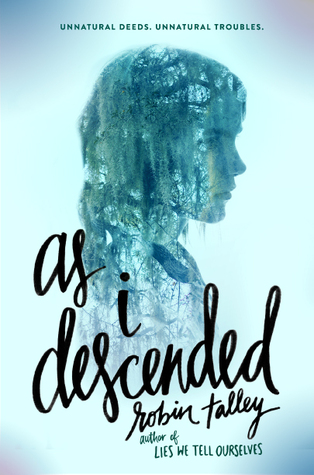
Review - "As I Descended"

As I Descended
by Robin Talley
rating:☆☆
published: 6th September 2016
spoilers? yes

Goodreads

Galley provided by publisher

I have mixed feelings about this book. On the one hand, it's actually a good book, and well-written, and I liked most of the characters. On the other hand, I might describe it as an exercise in how not to write an LGBT Shakespeare adaptation (if I'm being particularly harsh).

It took me a while to get properly into this book. I read the first chapter, then had the sudden (late) revelation that everyone in Macbeth dies, and for a book full of LGBT main characters, that isn't what I want to be reading about. At which point, I took a two week hiatus from reading it.

When I finally picked it back up, it was less because I wanted to read it and more that I couldn't bear knowing it still needed finishing. And it was all going well up until the 60% mark, when Brandon died and so did my motivation. Because I did know that someone was going to have to die, and the likelihood was that it would be an LGBT character, but I hadn't quite clocked that this one was the Banquo of the cast. And he was my favourite of the main characters.

This time there wasn't a two week pause, but I was pretty reluctant to pick it back up again. I think I skim read some of the scenes near the end in a desperate attempt to finish the book.

I'm not against characters dying, and I know that going into this that was to be wholly expected. And the characters didn't just die for shock value - they died because that was what Shakespeare wrote and the adaptation had to be mostly true to the play. What I didn't like was that 3 of the 4 LGBT characters in this book died. And one of them was the disabled character. Which seems pretty bad thinking from the author, in my opinion. I know their deaths aren't quite the same as authors who bury their gays, but it would have been so easy for, say the Banquo character, to go into a coma instead of dying. Or make them not gay. Or have the disabled character be the one who survives. I understand that's kind of hard if you're aiming to write a lesbian version of Macbeth, but I would so much rather have some bullshit deus ex machina reason for them living than read a book where three quarters of the LGBT characters die. And to top it off (aka the reason this pisses me off as much as it does), the straight character goes into a coma and wakes up. Thanks for that.

There were a couple of other bits I was leery about. When we first meet Mateo, and he's musing on Maria and Lily's relationship, he comments that both those girls seemed way too uptight to like pussy. Thanks mate. Then there's also the part where Maria, hearing Mateo has won a prize ahead of her, thinks something about him winning it because he's gay or whatever, conveniently seeming to forget that she has a girlfriend. But I suppose that's part of her deterioration towards the end.

Before both she and said girlfriend die.

At least Mateo got a happy ending, right?
Read More

Saturday, 21 May 2016

Review - "On The Brink"

On The Brink, In The Zone #0
by Kate Willoughby
rating:☆☆
published: 28th June 2016
spoilers? yes

Goodreads

Galley provided by publisher

Like with most of these kinds of novellas, I feel like they would actually work better as a full-length novel. As it is, there is not nearly enough time (~90 pages) for the required character development to be realistic or seem effective.

Mostly, my issue lay with the plot of this book seeming kind of unbelievable. The interview for one, seemed a bit confusing. Like, why would some newspaper be so interested in Jeremy's story? And the presidents desperate desire to promote how diverse and accepting his school is. I mean, I guess it's entirely plausible that a school president is that eager to promote diversity, but when it gets to the athletes willingly making this incredibly cheesy video to basically just prove that they're not homophobic or anything, that's when I call bull.

I could have probably lived with it, but that plot's that seem unreasonable and implausible tend to turn me off books, and that's compounded by my other issues.

Firstly, Jeremy is somewhat obsessed with Hart, before he even knows him. And it's a little creepy how much he knows about him, and how closely he watches his game. Also, the part where they meet when Jeremy goes to the players' entrance seemed a little contrived. Surely they could equally have met at an after-party of something? It would have made more sense.

The subsequent blowjob in the car in the parking lot of the ice rink was also pretty unrealistic. I mean, they've just me, Hart has told Jeremy he was putting him off his game, then all of a sudden the conversation switches to experimentation and how if you kiss a boy it doesn't make you gay, right? (You do know there are more than two sexualities, right, bud?) This then leads to this wonderful quote:

It [his cock] tasted good. Salty and earthy, like virility in 3-D. He gobbled up more of it...


I have trouble enough reading sex scenes because they're uncomfortable, but then ones that throw sentences like this in just put me off entirely (and make me burst into laughter, which I'm sure is not the author's intention). (See also, later on: You want to hear me grunt?)

A minor point: I'm not a huge fan of experimentation storylines to begin with - I mean, I don't mind them, but I wouldn't pick them over everything else - let alone ones where someone's desperately trying to convince themselves and the other person that they're not gay, while they've got their dick in that person's mouth.

There's also that really irritating thing where the characters seem to have to say 'I love you' to one another. Even when they've known each other for not that long, and it's really not believable. 'I like you lots' would have done surely.

A final final point, it did make me tear up a little when Hart said he had to deny himself to be big in the NHL. I'm weak. (And perhaps rating too harshly.)
Read More

Thursday, 19 May 2016

Review - "Dreams and a Home"

Dreams and a Home
by Max C. Payne
rating:☆☆
published: 1st June 2016
spoilers? yes

Goodreads

Galley provided by publisher

To be fair to this book, it isn't bad. If I hadn't had quite so many problems with it I might have rated it more highly than this.

First of all, the age difference between the two characters had me a bit dubious. I'm not a huge fan of big gaps so when I read that the narrator was 19 and this other guy was 32, I was... not particularly eager to continue reading, to say the least. What was even worse was that they first met, a fleeting acquaintance as it may have been, when he was only 18, and, coincidence upon coincidence, this other guy happened to be the architect designing the main character's parents' house renovations, when (get this) the main character was in high school. So you can see why I had my reservations. (I mean, he even says "I've wanted you since the first time I saw you, Nick, even if you were jailbait then." #romantic...)

Anyway, I continued reading. And it turned out that Nick (the MC) was pretty highkey misogynistic. I mean, get a load of some of these:

'Squeal worthy,' a girl would say.


It was a woman's job to be nosy.


[he's in there with] the skank of the week...


Lovely. Also, when his girlfriend claims he's using her, his rebuttal is that he's not having sex with her so obviously he can't be using her. Sorry to break it to you, bud, but there are more ways than that to be "using" someone.

The book had a setup where it flipped back and forth between the past and present (which, again, I'm not a huge fan of). It would have been fine, but for the various time skips that were slotted in there. A whole chunk of how they got together was taken up with a time jump, which is never going to convince me to like their relationship.

One mini-point slotted in here: why does Nick's coming out suddenly put him in mortal danger, and result in slights and bullying? Did I miss something? Is he in a ridiculously conservative school? I don't remember reading anything like that. Or maybe it's because he's technically in a relationship with a teacher. Which is just no. I actually hate that idea so much. Because there's such a power imbalance in a relationship like that, and it's just gross. Please don't.

My last point is entirely to do with the author's treatment of Nick's sexuality. There was a point where he mentioned not feeling any attraction to anyone until Eli, at which point I was like, hey! maybe this guy is going to be demisexual! But no such luck. Not even a hint of the d-word being mentioned. Then there's the part where he says gay, straight, bi, asexual: they were all just labels to me..., which is one of my hugest bugbears. I hate books where the minority character (often, just put in there to up the quota) is like, I don't believe in labels. If he had said he didn't want to label himself, or didn't know how to, I wouldn't be so annoyed but it's the we're-all-the-same-really-so-why-make-these-distinctions vibe that gets me with this don't-believe-in-labels crap. Anyway. Onwards.

There's a bisexual character in this! (*cheers*) A bisexual character who fits those gross stereotypes. (*boos*) First off, we're met with the assumption that, because this man is bi, he must always want sex, and he must be indiscriminate about who he has sex with. Thanks. Then, later on, he turns out to be a leering creep who shuts Nick in the bathroom at a club to proposition him and doesn't back off even when Nick says he's there with someone. Double thanks.

One last point on this: Nick describes the bi character as being comfortable with "their alternative sexuality". Alternative to what? Heterosexuality? Because I really don't like this statement. It's basically saying that heterosexuality is the norm and is right, and anything else is "alternative" to that. Also, it has a sense of choice in it, or at least it does to me. I thought we were past thinking of sexuality as a choice.

Finally, I would like to point out this quote:

I knew I looked fuckable.


I have nothing more to say.
Read More

Friday, 6 May 2016

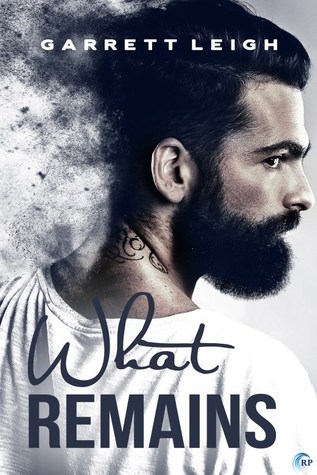
Review - "What Remains"

What Remains
by Garrett Leigh
rating:☆☆
published: 4th July 2016
spoilers? yes

Goodreads

Galley provided by publisher

What Remains follows the story of Jodi and Rupert after Jodi is the victim of a hit-and-run which results in Jodi having amnesia and not being able to recall anything of the previous five years of his life, with Rupert.

To be honest, I thought this book would have a different format than it did. I was expecting something like them meeting, getting together, then the accident, and subsequent recovery, but in fact it started with the accident, interspersed with memories of their meeting and relationship, before switching to the present once Jodi woke up. It's not a bad way of doing things, but it was a little disorientating at first, and also it felt like there wasn't enough in the way of how they met and got together. In a way, it kind of made the accident less angsty and emotional, because I knew next to nothing about their relationship beforehand.

Also at first, the book kind of dragged, and I had to motivate myself to read it, which is always going to cause my rating to lower, even if it later picks up and I enjoy it (which was the case here). The writing just wasn't doing it for me, which could have just been that I wasn't in the right mood or it wasn't for me, but also that it wasn't great.

There were various small things throughout the book that irritated me too. One is the arse slapping (which is like my biggest bugbear with this kind of lit. I hate it so much), but thankfully that only happened once. The other was the way the author wrote Indie's speaking. Like, I get she's a little kid, but I've never heard a kid of any age say "cwunchy cuddles". I don't even know what "cwunchy cuddles" is supposed to mean! Also, Rupert's incessant use of the word "boyo", which a) again I've never heard anyone say ("kiddo", yes, but not "boyo"), and b) is that supposed to be an attempt at marking him as Irish? O-K. (Same with the "aye", which, to me, is more stereotypically Scottish than Irish, but like, what do I know.) The word "boyo" really bugged me the most when he said it during sex scenes. Not gonna lie, it was pretty off-putting. Not to mention, that I associate that word with grandpas for some reason, which made it doubly so.

Despite my issues, this book still managed to make me emotional, especially when Jodi didn't remember who Rupert was (this is why I don't read amnesia fics, damnit!), so I'm maybe being a little harsh in my rating.
Read More

Tuesday, 15 March 2016

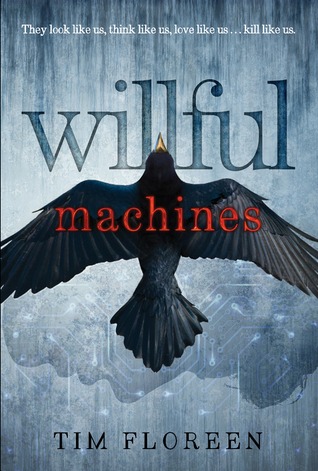
Review - "Willful Machines"

Willful Machines
by Tim Floreen
rating:☆☆
published: 20th October 2015
spoilers? yes

Goodreads

I don’t think I chose to be gay, if that’s what you mean. In fact, I didn’t choose a lot of things. Like being the son of the president. Or coming to Inverness. Or even being in the closet, really. All in all, I’d say I have about as much free will as an espresso maker.


As far as I can tell, I'm in a minority for disliking this one. I was really looking forward to it, too, not least because the evil robot was called Charlotte and I have a weakness for books where characters share my name.

I think part of my issue was that I kept comparing it, unintentionally, to Robopocalypse by Daniel H. Wilson, which, despite the slightly iffy title, is an amazing book about a robot apocalypse (which not enough people have read, therefore I will always recommend. Please go read it). Willful Machines is, obviously, a completely different book, but I always have trouble with comparing books that sound similar (see, The Wrath and the Dawn vs A Thousand Nights).

It wasn't that this book was badly written or anything. I mean, once everything got going, I enjoyed it well enough. But it took a while for everything to get going, and I don't really have patience for books like that most of the time (there are, of course, exceptions, but this was not one of them).

Also, the relationship was very very much instalove. I'm pretty sure they had like, 3 conversations before they decided to come out with the "I love you"s. Sorry, but I just can't believe it. That Nico was in fact a robot was pretty obvious too, which was annoying.

I liked that it was a story about a gay main character without it being a story about coming out though. Even if there was a slightly awkward bit at the end with Lee confessing he loved Nico. Calm down, boyo. You've known this guy for what? A month, maximum?

Basically, I was pretty disappointed, especially after hearing so many rave reviews (it has an average rating among my Goodreads friends of ~4.3, so I had high hopes), but that's life I guess.
Read More

Monday, 14 March 2016

Review - "Cambridge Blue"

Cambridge Blue, DC Gary Goodhew Mystery #1
by Alison Bruce
rating:☆☆
published: 1st January 2009
spoilers? no

Goodreads

You lose a child and you do understand each other's grief at first, but if you get out of step with each other, it's all over. Suddenly each of you is alone.


To be honest, I only picked this book up because it was a murder mystery set in Cambridge. That was it. Waterstones had it on a table of books set in Cambridge (along with The Grantchester Mysteries which I love the TV show of) and so I figured I'd trust Waterstones and read this.

Not my best idea, I gotta admit.

I should probably have guessed as such. I already know that I'm seriously easily annoyed when it comes to authors who haven't got the simple fact of a language correct, so when it's a town I know and they haven't got it right? Uh oh.

Which was the case here. I don't get it at all though, because apparently Alison Bruce lives in Cambridge, but the Cambridge she describes is not the one I know. For example: there is no "Rolfe Street" in Cambridge, nor a railway bridge that has railings you can look out over if you're heading out of town (and given where he was headed I assume it was Hills Road Bridge he was referring to which definitely doesn't have railings). Bradwell's Court hasn't existed since 2006 and this book was published in 2008. It's Christ's Pieces, not Christ's Piece. The flats on the Fen Causeway are not white and fancy. (Sorry I got carried away.) I know all these things might seem picky but they actually affect how easy I find it is to read the book. I kept stopping while reading it because the descriptions didn't make sense and I couldn't just let them go by.

That wasn't the only problem I had with this book though. The writing wasn't amazing and seemed kind of clunky in places. Also, did it even have a proofreader? I picked up "exelsior", "futher", "definately", and "thougthfully". "Exelsior" even appeared twice in the same page.

Neither did the mystery grab me all that much. The murderer was pretty obvious (especially when right at the beginning there's this comment about the guy being possessive. Like, if that's going to be the case, at least try make it a little less blindingly obvious maybe?) although the conclusion seemed pretty convoluted and I lost track of what was actually going on (something about a little brother being killed, and a girlfriend, and there was some incest thrown in there for good measure?).

I did like Gary though. Even if there was a little of the Brilliant Detective Syndrome going on. And also that weird stalkerish behaviour with the receptionist I can't remember the name of. Even if he did admit to knowing it was stalkerish and deciding to stop, I'm still leery about it.

Anyway, I'm going to go foist this book on my mum so we can have Deep Discussions over the incorrectness of the Cambridge descriptions.
Read More